What's in a name?
What I talk about when I talk about alternative proteins, Reese's peanut butter cups made with oat milk (powder) and Snoop Dogg wants to get you high...on cold brew.

Did you miss me? Last week, I attended Future Food Tech (FFT) in San Francisco. It’s the Olympics of the food-tech scene––a coming together of people from around the world all striving towards food industry change. (Although more attendees and more diversity would be nice.)
I tasted a lot of plant-based chicken. I chewed on dumplings made with algae protein wrappers. I drank a fizzy alcoholic drink that used egg protein made with precision fermentation. I discovered sparkling palm wine. I ate a lot of mycelium including as a scaffold to cell-cultured fish eggs. My week passed in curious nibbles, but almost never from a plate. Except the day when my lunch was iceberg lettuce dotted with sliced radishes. (It was all that was left.)
The week before the conference, I presented at the “Novel Foods” conference in Rome (via Zoom). In a bit of mashing two potatoes with one fork, I used interviews from my FFT prep to illuminate my Rome talk. It came down to the concept of “alternative proteins,” which is today’s catchall for anything that isn’t protein from an animal.
Alternative proteins is an insider term. It’s an investment category and a focus for a bunch of conferences. It’s a quickie elevator phrase when someone in food-tech wants to define what they’re doing. But the thing is we’re not actually getting *new* alternatives. Most of these startups are still primarily using soy and pea with a few rare birds using a small percentage of chickpea, fava or lentils.
What we’re getting are new forms of technology that push, pull, twist, and stretch plants to create meat-like things.
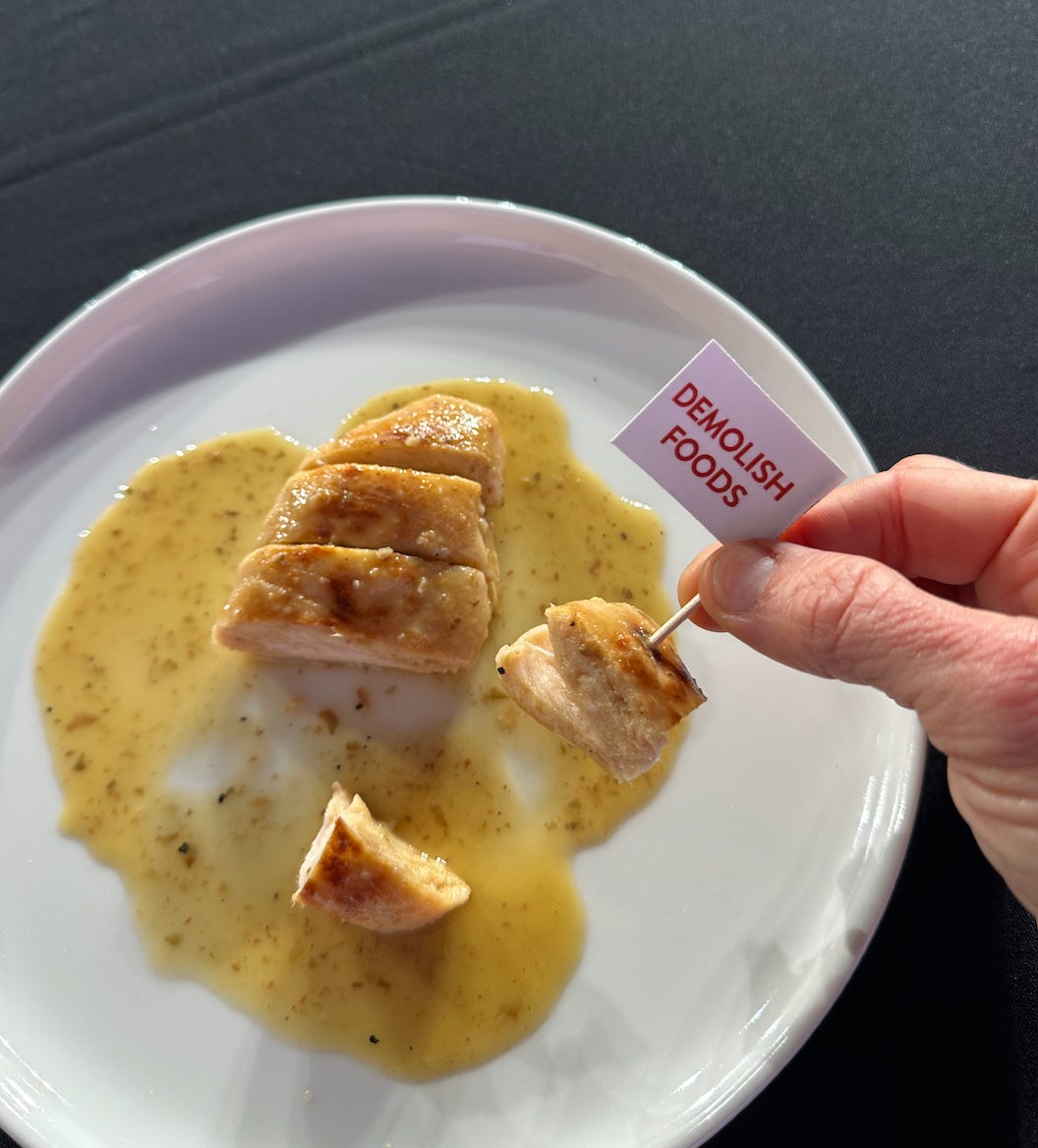
Most of today’s plant-based meats make use of high-heat extruders. (Cereal and baby food do, too.) This means the plant molecules are cooked, or denatured. One startup I talked to, Demolish Foods—based in India, is using micron thick plant protein fibers to craft ‘chicken’. Demolish structures plant fibers at room temperatures along with moisture, which creates a hydro-gel ultimately creating a raw product that end consumers can cook.
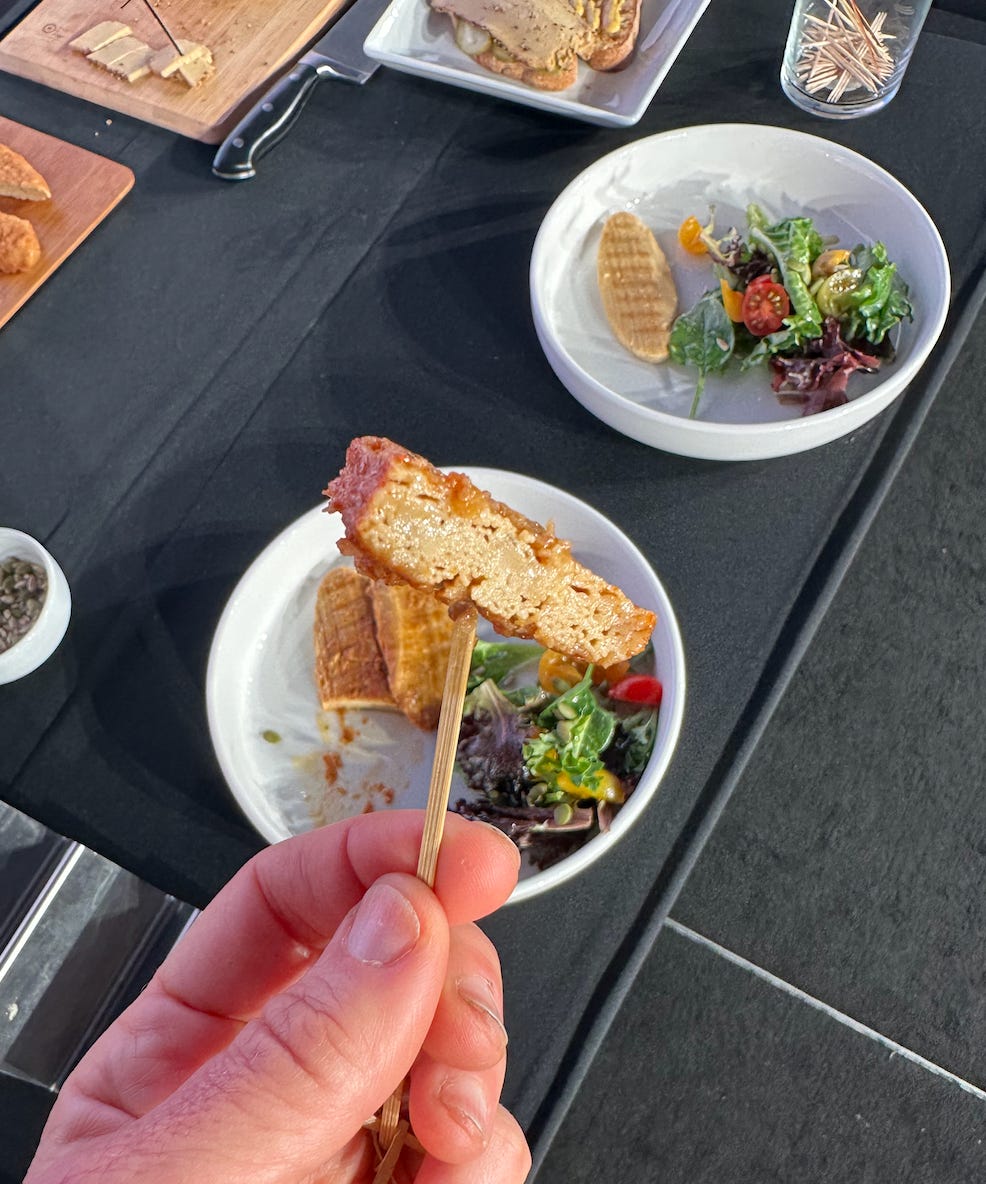
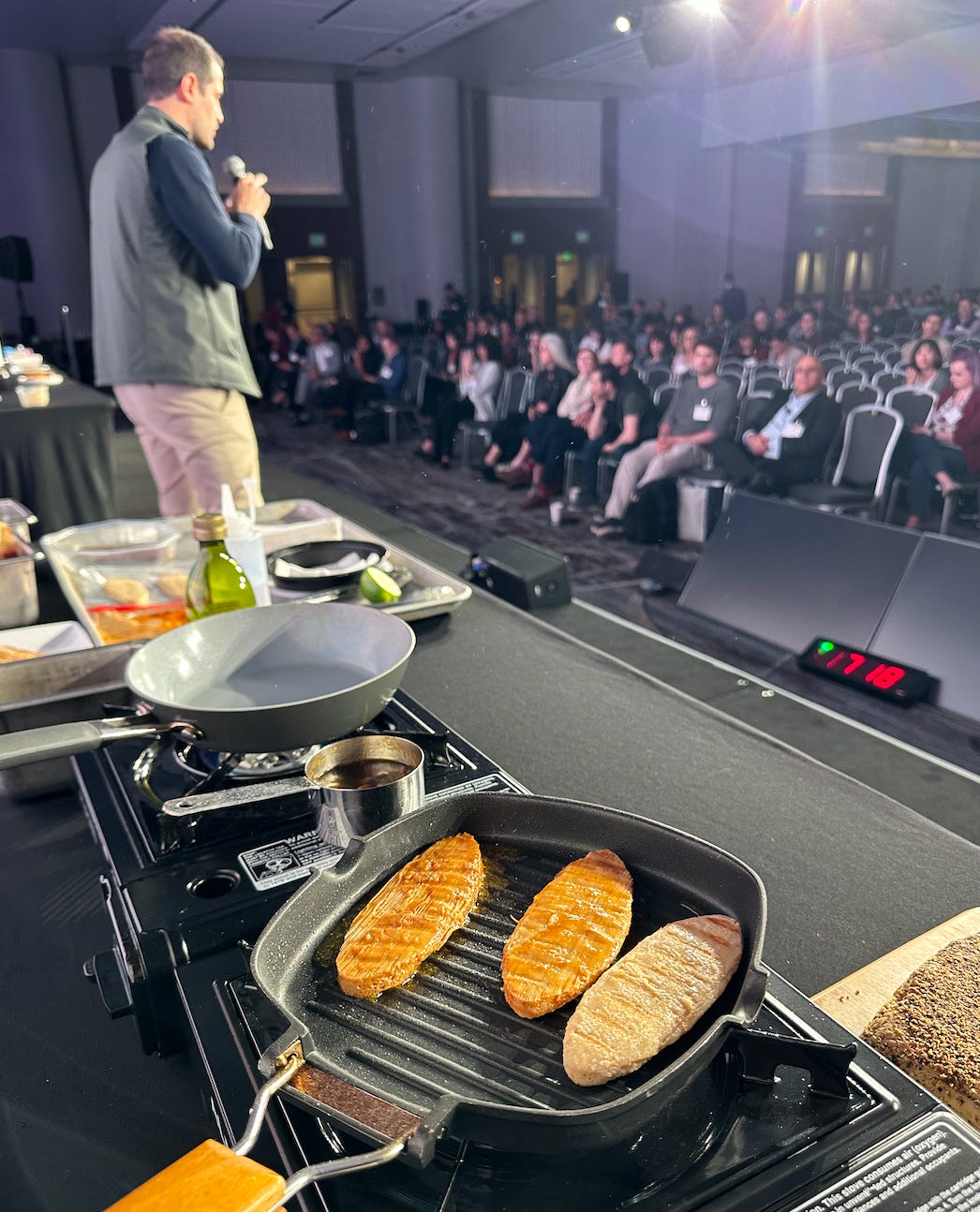
I tasted it on stage at FFT during a cooking demo. It looked like a chicken breast, and it was juicier than anything I’ve eaten to date. Then I tasted ‘chicken’ from Novameat, based in Spain. In its early days, Novameat used a 3D printer to draw (paint? create?) blocks of protein. Today, the startup is using micro-extrusion that also doesn’t rely on high heat. Still sounds much like 3D printing, but the founder tells me he can make use of equipment found in meat production facilities.
Novameat’s chicken was springy and chewier, but it felt more like tofu or vital wheat gluten. Definitely not as chicken-like as the bite I ate from Demolish. Both startups are relying on the thinnest of fibers––as fine as hair, or finer––to create something new. And along with fat, they are, but they’re still using the same base ingredients: Novameat uses yellow pea protein and Demolish uses soy.
It’s unlikely the industry will change, but do we need to rename alternative proteins to be more accurate? How about Alt-Meat? That’s what we’re really doing here—re-making the everyday foods we eat. We don’t actually need more sources of protein, we’re set there. We aren’t getting more biodiversity, although that would be nice. We need healthier foods bottom line. Healthier-Alt-Meat? Ham? Maybe that’s it.
Anyways, if you’re curious, my own favorite alternative proteins disguised in snack form are Brami lupini beans or Moon Cheese.
Other tidbits:
Reese’s peanut butter cups (also the candy I will most likely fish out of a child’s plastic Halloween pumpkin) were re-formulated by Hershey’s with oat milk instead of cow milk. Are they yummy? I don’t know yet because I can’t find them!
Want to check the carbon footprint of your weekly groceries? A container of Greek yogurt from Whole Foods gets 2 kg of CO2. (Most of this number comes from agriculture; next, but far lower, is packaging.) My crackers also earned a 2, but the cause was more diverse. The new tool, CarbonCloud, is a bit clunky, and gives incorrect results but for those of us who are patient, perhaps it will be rewarding.
Low-carb diets work? You bet they do, and especially for people with Type-2 diabetes according to a recent study out of Harvard. Researchers looked at 34 years of data from over 10k people and found that sticking to a plant-based, low-carbohydrate diet was associated with a reduction in overall, cardiovascular, and cancer mortality. The strongest health benefits were found among people who exercised, didn’t smoke and consumed moderate amounts of alcohol. Wah, I know. It sounds so un-fun but sticking to these diets still allows for weekly caloric splurges! (Like the scone I’ll hike with on Saturday.)
Big names continue to worship at the beverage case: Snoop Dogg launched an Indonesian canned cold-brew coffee called INDOxyz using Indonesian coffee beans. I love cold brew, although I wish someone would come out with a decaf ready-to-drink version. Sierra Nevada invested in Riot energy drinks and while the name feels a bit misleading and like something I wouldn’t drink, turns out the ingredients are natural and the “energy” is from green tea.

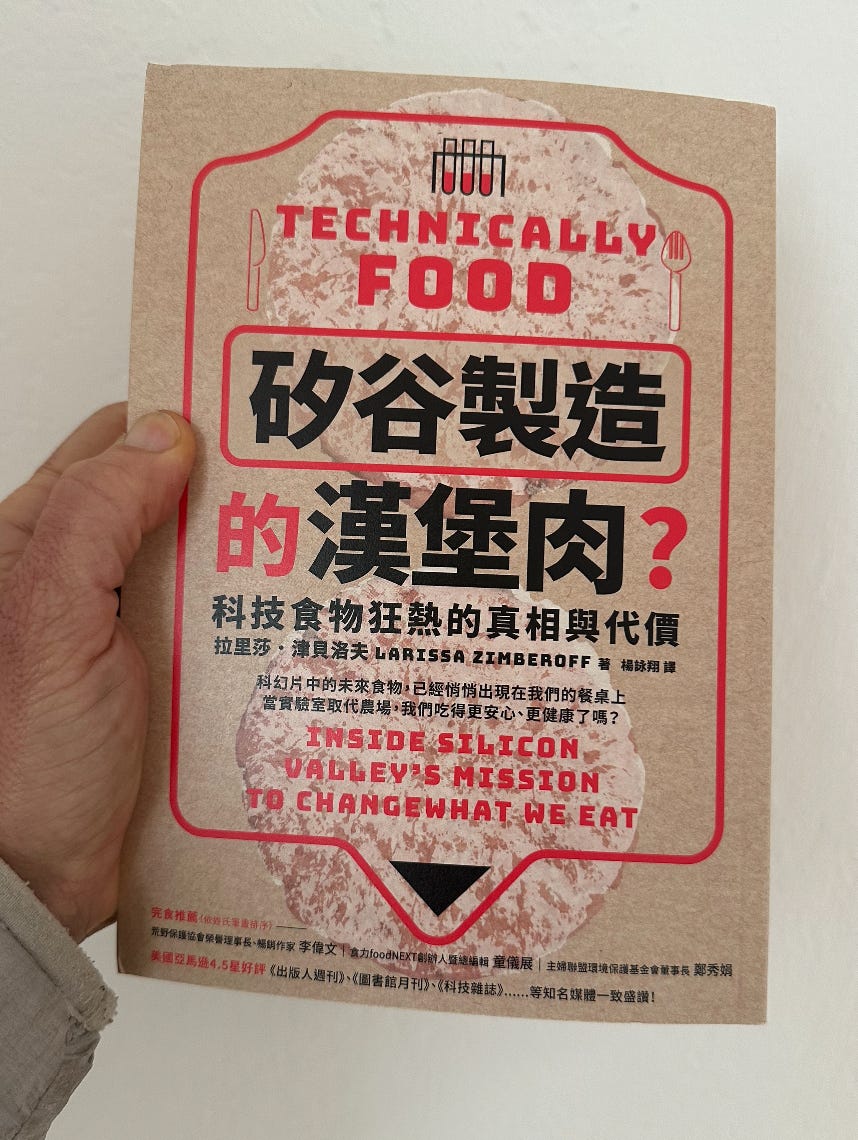
Not a very inspiring cover, but still a thrill to see my book translated. I’m giving it away to the first person who emails me here.
Where you can find me:
I wrote about the first ever plant-based poached egg for the SF Chronicle. (Please subscribe for $1!) It’s a great story about Yo! Egg, an Israeli startup, and chef Kenny Annis, who owns a vegan spot in South San Francisco called Sky Cafe. H/t to David Benzaquen who introduced me to Yo! Egg over a year ago.
My short piece on the benefits of kefir appeared in the Washington Post. (It originally appeared in Consumer Reports.)
I’m attending Google Food Lab in late April, which, oddly, will be my first time seeing the Google Mountain View campus.
My publisher sent me two copies of my book in simple Chinese. (It’s also translated into Korean and Mandarin.) Do you want a copy? I’ll give one copy away to the first person that leaves a comment here saying: Me Me Me.
Me, Me, Me! I read traditional Chinese. Native fluency in Mandarin.☺️
I heard about you on YouTube while watching Dr. Shiva and that's how I got hooked on Technically Food!