Canadians miss bourbon!
In this newsletter: tips for how to deal with produce during peak cyclospora, the unusual place where you can find soy milk, and the new high-protein legume coming for your dinner.

Hello and welcome to Technically Food. I’m back from my summer road trip, which took me through Oregon, Washington, Vancouver Island, Sunshine Coast, BC and Vancouver, BC. Until this trip I’d never been on a car ferry and I’m here to tell you they’re amazing. They run on time (in Canada), feel like cruise ships and you can spot whales from the deck if you’re paying attention. We spotted orcas and humpbacks.
Some interesting things I gleaned on the trip: there are wild berries growing everywhere—thimble berries, cloud berries, blackberries and raspberries; you can’t find American bourbon on the menu or on the shelf (and the Canadians we spoke to are sad); soy milk is available at most coffee shops; and gas is cheaper but you have to convert liters to gallons and CAN to USD. (This is when we’re happy to have AI helpers.)
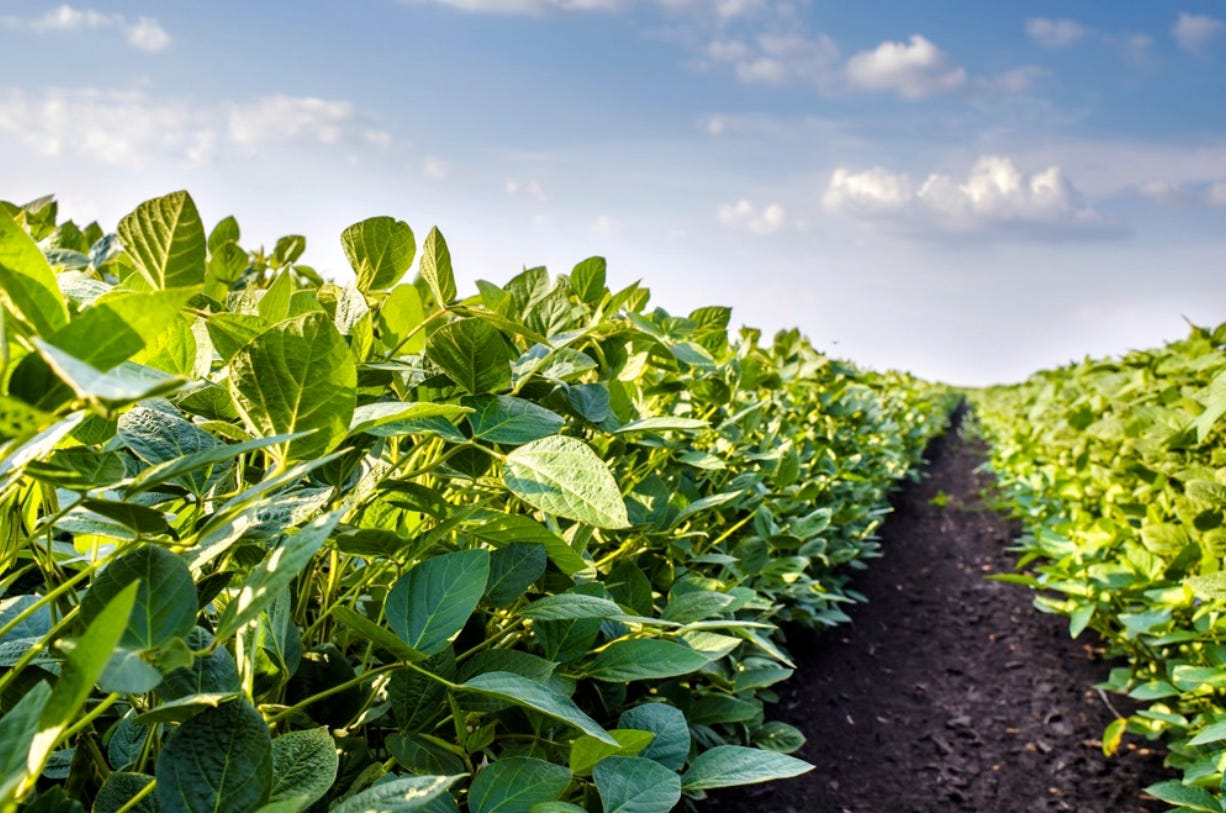
The ease with being able to order soy milk was surprising. I can’t find it offered in any coffee shops in the US. None. Why is soy still so maligned? Aren’t we past that? (That being an old concept that soy beans have phytoestrogens that are bad for us.) The macros are infinitely better than oat and almond milk. Someone bring it back please.
As for bourbon, and any other American spirits, Canadian liquor boards pulled American brands off the shelf in retaliation to Trumps tariffs.
I didn’t eat as many salads on my road trip, but I couldn’t help but take note of the cyclosporiasis outbreaks — and there’s a new one being reported this week. The illness is being linked to iceberg lettuce grown in Mexico for Taylor Farms, which is a $7-billion-dollar company (so don’t feel bad for them). And if you’re thinking it’s just a US-only problem, it’s not. A writer colleague came down with it in Italy recently. (You can read her story here.)
I won’t add more to the already busy news cycle but if you’re wondering how you can be safer, knowing that eating what you don’t grow will always have risks, here are some things you can do:
Skip buying bagged salads. They’re convenient but they include ingredients from multiple locations, which make it hard to trace and most folks aren’t going to wash those little leafs before tossing them in a bowl. From an article in Time magazine: “Just because something says pre-washed doesn’t mean [it’s safe].”
Buy whole leaf lettuce — iceberg, romaine, etc; remove the outer leaves and then wash the whole set in a salad spinner or loose in your sink. “Broken leaves are more vulnerable because ‘that’s how the bacteria gets inside.’”
Cook your lettuce — spinach, cabbage, etc, which will kill all bacteria and is also extremely delicious. Even better: grill your lettuce.
If you’re at the farmers market (good), ask the vendor where the greens were grown. You want the answer to be a farm they’re connected to, not an intermediary.
One important note. The only assured way to rid your produce of cyclospora is to cook it, otherwise buy organic, avoid fast food restaurants and follow the steps above.
More great advice can be found in this recent article in Time magazine.
I’m just here for the tidbits:
A former UC Davis professor who read my book told me that peas aren’t our protein future but chickpeas are. I’ve kept this filed away in my head until reading about new chickpea varieties that are even higher in protein with less flavor issues. Almost 500,000 acres are planted with chickpeas in the US. It sounds astronomical, right? (Nope. There are around 64.5 million acres of soybeans planted.) NuCicer, a Davis-based biotech company, has created a variety they’re calling Nuchi. It’s 50% more protein and 25% less fat than standard chickpeas. This eliminates a de-fatting step required to turn chickpeas into concentrated protein. (Similar to how whey or soy protein concentrate is created.) Speaking of high protein beans, have you tried Brami’s high protein pasta made with lupini beans? It’s great.
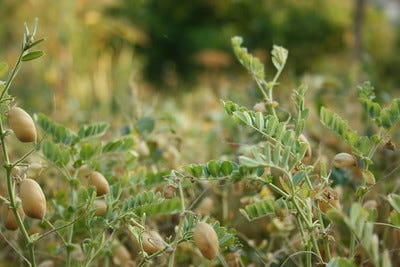
I never knew what chickpeas looked like in the field! Photo by Flickr/Go Nat And speaking of processing, a new study out says that the problem with ultra processed foods (UPF) could actually be more in the the processing versus the ingredients—salt, sugar, fat and flavoring. Researchers found that every 10% of energy supplied from UPFs resulted in a higher body mass index, higher metabolic syndrome, diabetes, and higher risk of all-cause mortality. (All the bad stuff.) After adjusting for diverse aspects of nutritional quality—basically removing the ingredient differences, and looking again at health outcomes, they found that the long list of adverse risk factors were only partly explained by nutritional quality. Researchers hypothesize that the processing is more culpable than low nutrient density. We know UPF isn’t a health food, but does anyone think that we’ll ever get to exactly why they’re so bad? Or, do we even need to?
Following the Big Tobacco playbook, here’s a report on the many ways Big Food wages legal battles fighting against public health policies that might lower the rise in chronic disease. This includes front of pack labeling, advertising junk food to children, soda taxes, and taxes on ultra processed foods. The report found that 239 lawsuits were filed between 2010 and 2025 across Mexico, Colombia, Brazil, the US, the UK, and India. The most common plaintiffs were Coca-Cola, PepsiCo, and Mondelez. Talk about obstructionist litigation.
Where you can find me:
Join me for a two-day natural wine fair in Berkeley this weekend. Unfiltered highlights low-intervention wines made in the nine counties around the Bay Area. Here’s news coverage from KRON about the festival. I’ll be there on Sunday.
I have a recent article in Provoked Magazine covering how difficult it is to make healthy choices in the supermarket.
Back at my desk. Need something? Drop me a line.
I had not heard of Brami's high-protein pasta. Will have to check that out. And interesting about Nuchi. As for soy milk, I'd recently noticed that it wasn't as available in coffeeshops, which is a bummer. I do like oat milk, but I prefer soy milk lattes. You think it's because of that lingering, negative association with soy, huh? I thought it might be due to oat milk's popularity and success and the likelihood of that being chosen over soy.
Canadians miss bourbon!
Yeah. Canadian whiskey is practically an oxymoron. It certainly can't trump—excuse the expression—the good-sippin' kind. But oh my! Without demeaning any discussion about good food and drink with bad politics, what puns we could make about the reason for the dearth of American whisky in the fifty-first state. Oops. Didn't mean that.